PostgreSQL is the best general-purpose database ever shipped. I want to say that first, plainly, because the rest of this post argues that for a specific and growing class of workloads it is the wrong choice — and that argument only lands if you know it comes from respect. The question this post answers is not "which database is better." It is "at what point does adding AI capabilities to PostgreSQL cost more than moving to an engine that was built for them?"
We have a narrower, code-level comparison in SynapCores SQLv2 vs PostgreSQL and a pgvector-specific one in SynapCores vs pgvector. This piece is the architectural decision that sits above both.
The AI-native engine in this comparison is SynapCores — vector search, a graph engine, SQL, and in-database AutoML in a single self-hosted binary, with native MCP support and an OpenClaw long-term-memory plugin built in. The Community Edition is free. Download the free Community Edition →
A note on scope. Capabilities marked (Enterprise / roadmap) are part of the Enterprise tier or roadmap and are not in the free Community Edition today. Everything unmarked is in the free CE you can download right now.
What PostgreSQL does that nothing should replace
If your workload is transactional — orders, accounts, inventory, anything that needs ACID guarantees and complex joins across normalized tables — PostgreSQL is excellent and you should keep using it. Its planner is battle-tested, its extension ecosystem is enormous, its replication and backup tooling is mature, and there is a deep pool of people who know how to operate it. None of that is in dispute.
The trouble starts when an AI feature lands on the roadmap and the instinct is "we already run Postgres, let's just add the extension."
The pgvector path, and where it bends
Adding vector search to PostgreSQL means installing pgvector, choosing an index type, and wiring up an external embedding service because Postgres cannot generate embeddings itself.
-- PostgreSQL + pgvector: extension, custom operators, external embeddings
CREATE EXTENSION vector;
CREATE INDEX ON documents USING hnsw (embedding vector_cosine_ops);

-- Embeddings come from somewhere else (OpenAI, a local model server)
-- Your application generates the vector, then sends it in:
SELECT * FROM documents
ORDER BY embedding <-> '[0.013, -0.21, ...]'::vector
LIMIT 10;
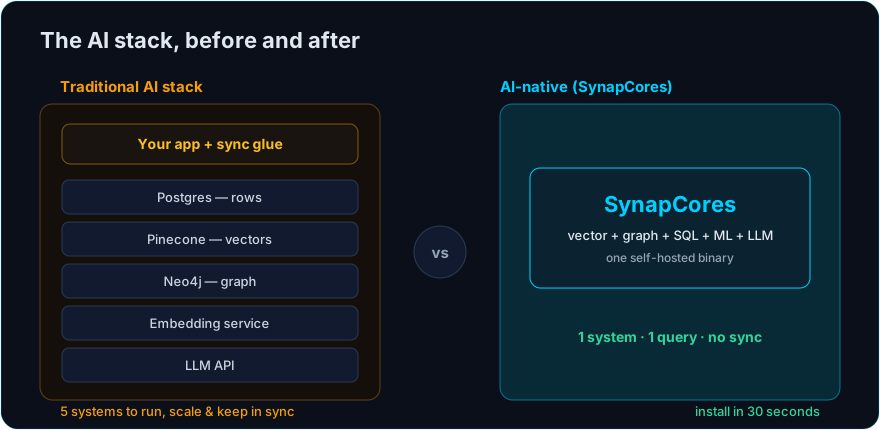
This works, and for a single semantic-search feature it works fine. The bend appears when the feature list grows. You need embeddings, so you run an embedding service. You need forecasting, so you add TimescaleDB. You need recommendations or classification, so you stand up an ML pipeline. You need graph relationships for GraphRAG, so you add Apache AGE or a separate Neo4j. Each addition is reasonable on its own. Together they reconstruct the exact five-system stack that AI-native architecture was designed to collapse.
The AI-native version of the same query keeps everything in one statement, because embedding generation, vector indexing, and ranking are native:
-- AI-native: embedding generation and vector search built in
SELECT title,
       COSINE_SIMILARITY(embedding, EMBED('how do I speed up my database?')) AS relevance
FROM documents
WHERE relevance > 0.7
ORDER BY relevance DESC
LIMIT 10;
No extension, no external embedding round-trip, no second system to keep in sync.
The real cost is the glue, not the queries
Benchmarks comparing query latency miss the actual cost of the PostgreSQL-plus-extensions path. The cost is operational. Every external service is something to deploy, monitor, secure, version, and pay for. Every sync between Postgres and a vector store is a consistency problem you now own: when a row changes, its embedding must be regenerated and the vector store updated, and if those drift, your search returns stale results no test will catch.
| Capability | PostgreSQL stack | AI-native database |
|---|---|---|
| SQL + ACID | Native, excellent | Native |
| Vector search | pgvector extension | Native, planner-aware |
| Embedding generation | External service | Native (EMBED()) |
| ML predictions | External pipeline | Native (PREDICT()) |
| Time series / forecasting | TimescaleDB extension | Native |
| Graph traversal | Apache AGE / separate Neo4j | Native graph engine |
| GraphRAG | Multiple stores, app-side glue | One engine |
| Systems to operate | 3–5+ | 1 |
A decision rule
Here is the rule I give people who ask. Stay on PostgreSQL if AI is a feature at the edge of an otherwise transactional application — one semantic-search box, a single recommendation widget — and you are comfortable owning the embedding pipeline. The extension path is cheaper than a migration when AI is genuinely peripheral.
Move to an AI-native database when AI is becoming the workload rather than a feature: when you are running RAG or GraphRAG in production, when you need vectors and graph and ML predictions in the same queries, when the sync jobs between your stores have started showing up in your incident reports, or when you are building agentic systems that need to retrieve, reason, and predict in one round-trip. At that point the unified engine is not a luxury — it is less code, fewer services, and one consistency boundary instead of five.
You do not have to choose blindly
The Community Edition is free and installs in about 30 seconds, so the cost of testing the AI-native path against your actual queries is an afternoon, not a procurement cycle. Run your hardest hybrid query against both and compare the architecture you would have to maintain, not just the milliseconds.
Download Free → · Read SQLv2 vs PostgreSQL → · See the live demos →