Agentic systems break databases in ways that ordinary applications do not. An agent is a loop: it perceives, decides, acts, observes the result, and repeats — often dozens of times to complete one task, often calling tools, retrieving context, and updating its own memory at every step. The database is no longer a passive store the application reads from; it is part of the agent's cognition. It holds the agent's long-term memory, serves as a tool the agent invokes directly, and tracks the state of work in flight. This post is about what that demands from a database, and why an AI-native engine is built for it in a way a traditional one is not.
If you are building agents, the related deep dives are worth reading alongside this: Agentic Memory System, Under the Hood of Agentic Memory, and Building AI Chat Memory Systems.
The engine described here is SynapCores — vector, graph, SQL, and in-database AutoML in a single self-hosted binary, with native MCP support and an OpenClaw long-term-memory plugin built in. The Community Edition is free. Download the free Community Edition →
A note on scope. Capabilities marked (Enterprise / roadmap) are part of the Enterprise tier or roadmap and are not in the free Community Edition today. Everything unmarked — including native MCP and the OpenClaw memory plugin — is in the free CE.
Why agents stress a database differently
A conventional web request touches the database a handful of times and returns. An agent doing real work issues a long, branching sequence of reads and writes, and the quality of each retrieval shapes what the agent does next. Three properties of agentic workloads matter:
First, retrieval is semantic, not exact. The agent rarely knows the primary key of the fact it needs; it knows the meaning of what it is looking for. That is a vector-search problem on every step.
Second, memory is relational. What the agent learned about a user connects to what it learned about that user's project, which connects to a decision made three sessions ago. Flattening that into isolated text chunks loses the structure the agent needs to reason. That is a graph problem layered on the vector problem.
Third, the loop is latency-sensitive in aggregate. A 200-millisecond retrieval is invisible in a single web request and crippling inside a forty-step agent loop, where it compounds into seconds of dead time per task. The retrieval path has to be fast because it runs constantly.
A multi-store stack — vector database here, graph store there, relational database for state, all glued in application code — pays the network tax on every one of those steps, and owns the consistency problem of keeping them aligned while the agent writes to all three.
Memory: the agent's long-term store
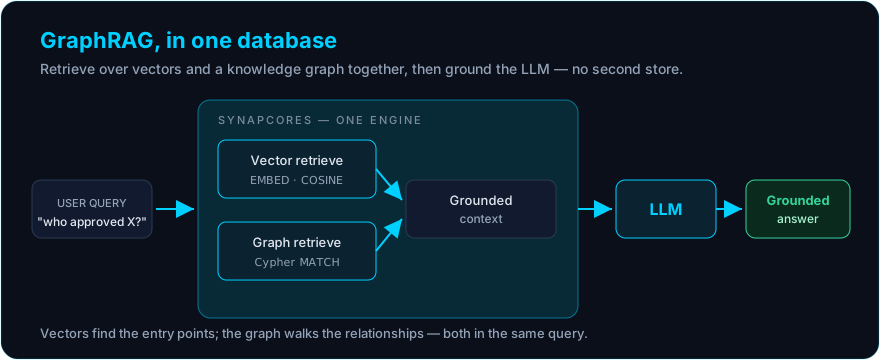
An agent's memory is the canonical AI-native workload. New experiences arrive as text, get embedded, and are stored with links to the entities and prior memories they relate to. Recall is a semantic search expanded by graph traversal: find memories similar to the current situation, then walk outward to connected context. In an AI-native engine this is one query against one store.
-- Recall: semantically relevant memories, expanded along their relationships
SELECT m.content, m.created_at
FROM GRAPH_TRAVERSE(
       seeds => (
         SELECT id FROM agent_memories
         WHERE agent_id = :agent_id
         ORDER BY COSINE_SIMILARITY(embedding, EMBED(:current_context)) DESC
         LIMIT 8
       ),
       hops => 2
     ) AS m
ORDER BY m.created_at DESC;
The OpenClaw memory plugin provides this durable long-term memory out of the box, so you are not hand-rolling the embed-store-link-recall cycle. The mechanics of structured versus summarized memory are covered in Conversation Memory: Structured Facts and Conversation Memory: Rolling Summary.
Tools: the database as something the agent calls
Modern agents act through tools, and the cleanest way to expose a capability to an agent is the Model Context Protocol (MCP). Because SynapCores supports MCP natively, the database is itself a tool server: an agent can query data, run a vector search, traverse the graph, or invoke an in-database model through the standard protocol, without you building and maintaining a bespoke API layer in between. The agent's planner sees the database as a first-class tool, and the round-trip from "decide to look something up" to "have the answer" is one protocol call, not a chain of services.
State: tracking work in flight
Agents also need durable state — what task is in progress, what steps have completed, what the agent is waiting on. This is ordinary relational data, and the advantage of the unified engine is simply that it sits beside the memory and the vectors. The agent's state, its memory, and its retrievable knowledge share one transaction boundary, so a single step that records progress, writes a new memory, and links it to an entity is atomic rather than three writes to three systems that can partially fail.
In-loop inference
Some agent decisions are better made by a model than by the language model itself — a fast classifier deciding whether a request is in scope, a scorer ranking candidate actions, a predictor estimating a value. Running these inside the database with PREDICT() keeps them in the same low-latency path as retrieval, instead of adding another external service to the loop.
-- Score candidate actions with an in-database model, no external call
SELECT action_id, action,
       PREDICT(expected_value, :agent_id, action_id) AS score
FROM candidate_actions
WHERE task_id = :task_id
ORDER BY score DESC
LIMIT 3;
Why this adds up to AI-native
An agent needs semantic recall, relational memory, durable state, tool access, and occasional inference — repeatedly, fast, and consistently. An AI-native database supplies all of those from one engine with one consistency boundary and native MCP so the agent can reach them directly. A traditional stack can be assembled to do the same, but every step pays the network tax and every write multiplies the ways your agent's memory can drift out of sync. For agentic systems, the unified engine is not a convenience — it is the difference between memory you can trust and memory you have to constantly reconcile.
Build an agent on it for free
The free Community Edition ships with native MCP and the OpenClaw memory plugin, installs in about 30 seconds, and is the fastest way to give an agent durable, retrievable memory on your own machine.
Download Free → · Explore agentic memory → · See the live demos →