Neo4j is the database most people reach for when they hear the word "graph," and for good reason — it is the most mature native graph database in existence. So when a team building AI features starts thinking about relationships, knowledge graphs, and GraphRAG, Neo4j is the obvious candidate. This post is about why "obvious" and "right" are not always the same thing, and specifically about what happens when graph traversal is only one of several capabilities your AI workload needs.
We have a retrieval-pattern-focused companion to this in GraphRAG vs Neo4j; this post is the broader engine comparison.
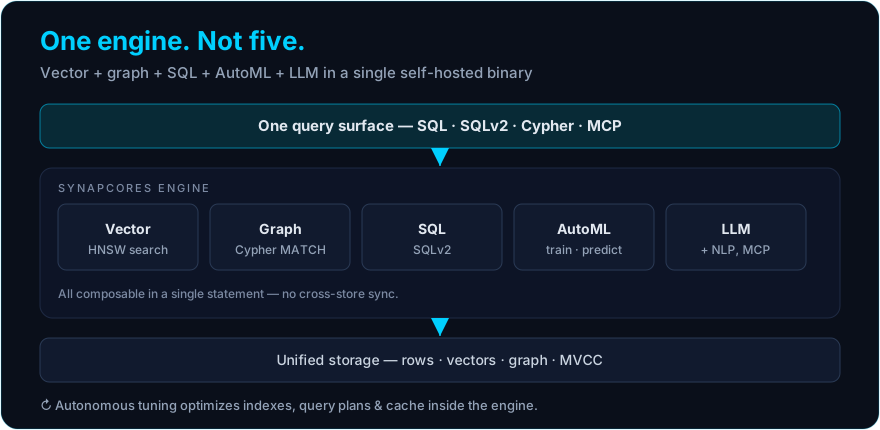
The AI-native engine here is SynapCores — vector, graph, SQL, and in-database AutoML in a single self-hosted binary, with native MCP support and an OpenClaw long-term-memory plugin. The Community Edition is free. Download the free Community Edition →
A note on scope. Capabilities marked (Enterprise / roadmap) are part of the Enterprise tier or roadmap and are not in the free Community Edition today. Everything unmarked is in the free CE.
What Neo4j is genuinely great at
Neo4j is a native property-graph database with fifteen-plus years of production behind it. It popularized Cypher, the graph query language that most other engines now imitate, and Cypher is a pleasure to write: MATCH (a)-[:KNOWS]->(b) WHERE a.name = 'Alice' RETURN b is exactly the right level of abstraction for traversal. Its multi-hop performance on graphs of hundreds of millions of nodes is excellent, its tooling for clustering and visualization is mature, and its graph data science library is deep. If your problem is fundamentally a graph problem — fraud rings, network topology, recommendation graphs, knowledge graphs you query directly — Neo4j is a superb choice and this post is not trying to talk you out of it.
Where the single-purpose design starts to cost you
The limitation is not in what Neo4j does; it is in what it does not do natively, and what that forces you to assemble around it. AI workloads rarely need only graph traversal. They need vector similarity to find relevant content, graph traversal to expand context, relational filters to enforce permissions and business rules, and increasingly model inference to score or classify results.
Neo4j added vector indexes in version 5.11, and they work, but they are a secondary citizen of an engine built for traversal — not at parity with dedicated vector indexing for high-recall retrieval at scale. There is no embedding generation inside Cypher, no PREDICT() for in-database inference, and relational joins across large indexed tables are not what the engine is tuned for. So the moment your AI feature needs more than graph, you are back to assembling a multi-store stack: Neo4j for the graph, a separate vector database for embeddings, an external service for the models, and sync jobs holding it all together.
| Capability | Neo4j | AI-native database |
|---|---|---|
| Native property-graph storage | Excellent | Native |
| Cypher / traversal ergonomics | Best in class | Native graph traversal |
| Vector search | Added in 5.11, secondary | Native, planner-aware |
| Embedding generation | External service | Native (EMBED()) |
| In-database ML inference | Out of scope | Native (PREDICT()) |
| Relational joins at scale | Not the focus | Native |
| GraphRAG in one engine | Needs vector DB alongside | Single engine |
The GraphRAG case, concretely
GraphRAG needs two capabilities at once: a vector index to find the seed nodes by similarity, and a graph engine to walk outward from those seeds. On Neo4j, the common architecture is dual-store — Neo4j plus a separate vector database like Pinecone or Weaviate. That means two systems, two copies of related data, and a sync problem: when a document changes, both its embedding in the vector store and its node in the graph must update together, or retrieval silently degrades.
On an AI-native engine, the seeds and the edges live in the same storage, so the retrieval is one statement:
-- GraphRAG in one engine: vector seeds + graph expansion, no dual-store sync
SELECT n.title, n.content
FROM GRAPH_TRAVERSE(
       seeds => (
         SELECT id FROM documents
         ORDER BY COSINE_SIMILARITY(embedding, EMBED(:question)) DESC
         LIMIT 5
       ),
       hops => 2
     ) AS n;
No second database to provision, no embedding-to-node drift to monitor. For the full pattern, see AI-Native Database for GraphRAG and What Is GraphRAG?.
How to choose
Choose Neo4j when graph is the workload, not one ingredient of it — when you are querying the graph directly, leaning on Cypher's ergonomics and the graph data science library, and vectors and ML are either absent or genuinely peripheral. Its maturity and tooling are real advantages for graph-centric problems.
Choose an AI-native database when graph traversal is one capability among several your AI feature needs in the same query path — vectors, relationships, relational filters, and inference together — and you would rather not own the sync between a graph store, a vector store, and a model service. The unified engine trades some of Neo4j's graph-specific depth for the ability to do the whole hybrid query in one place, with one consistency boundary.
See the unified engine run
The free Community Edition installs in about 30 seconds and gives you vector, graph, SQL, and AutoML in one binary — the simplest way to feel what "graph plus everything else" looks like without standing up a multi-store stack.
Download Free → · Read GraphRAG vs Neo4j → · See the live demos →