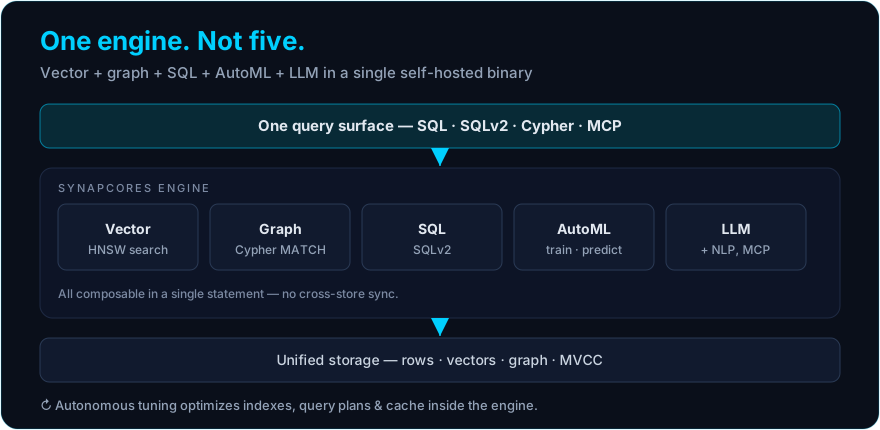
Choosing an AI-native database for a single project is mostly a question of capability fit. Choosing one for an enterprise is a different exercise, because the engine now has to satisfy security, compliance, operations, and finance teams in addition to the engineers who will build on it. The capabilities that win a proof of concept — vector search, graph traversal, in-database ML — are necessary but nowhere near sufficient. This post is the checklist I would hand an enterprise team evaluating the category, organized by the stakeholder who will ask each question, so nothing surfaces late in a security review after the technical decision is already made.
For the capability foundation underneath this, see the AI-Native Database guide and AI-Native Database Architecture.
SynapCores is the engine referenced throughout — vector, graph, SQL, and in-database AutoML in a single self-hosted binary, with native MCP and an OpenClaw long-term-memory plugin. The Community Edition is free; enterprise capabilities are noted where relevant. Talk to us about Enterprise → · Download the free Community Edition →
A note on scope. Capabilities marked (Enterprise / roadmap) are part of the SynapCores Enterprise tier or roadmap and are not in the free Community Edition today. Everything unmarked is in the free CE you can evaluate now.
Data control and deployment
The first enterprise question is rarely about features. It is "where does our data live, and who can touch it?" For organizations in regulated industries or with sensitive data, sending records to a managed cloud or an external embedding API is a non-starter. The requirement is self-hosting: the engine runs on infrastructure you control — your VPC, your on-prem hardware, an air-gapped environment if needed — and generates embeddings and runs inference in-process so data never leaves the boundary.
This is exactly where a single self-hosted binary that does embedding, vector search, graph, and ML internally has a structural advantage over a stack that calls out to an external embedding service: there is no external call to govern in the first place.
Security and access control
Security teams will want, at minimum: encryption in transit and at rest, role-based access control with the granularity to scope who can read which data and invoke which functions, audit logging of access and changes, and a credible answer on secrets management. For AI-native engines specifically, ask how access control extends to the AI surface — can you scope which roles may run a given model or reach a given vector collection — and how the MCP tool interface is authenticated, since exposing the database to agents widens the surface. Fine-grained access control, audit trails, and enterprise authentication integration are typically (Enterprise / roadmap) capabilities; confirm what tier each lives in before you assume it.
Scale and performance under real load
A demo runs fast on a small dataset. The enterprise question is how the engine behaves at production scale and concurrency. Probe for horizontal scaling across nodes, behavior of the vector index at your real corpus size and recall target, graph traversal latency at your relationship depth, and how hybrid queries — vector plus graph plus relational in one statement — perform under concurrent load rather than in isolation. Autonomous tuning and elastic scaling that adjust to workload automatically are powerful but are (Enterprise / roadmap) capabilities; the unified single-node engine is what you get in the free tier, and you should benchmark that honestly against your numbers.
| Requirement area | What to verify | Typical tier |
|---|---|---|
| Self-hosting / data residency | Runs in your VPC / on-prem / air-gapped | Community Edition |
| Unified vector + graph + SQL | One engine, one query plan | Community Edition |
| In-database ML / AutoML | EMBED, PREDICT, CREATE EXPERIMENT |
Community Edition |
| Native MCP for agents | Standard tool interface | Community Edition |
| Fine-grained RBAC + audit | Per-role data and function scoping | Enterprise / roadmap |
| Autonomous tuning + elastic scale | Workload-driven optimization | Enterprise / roadmap |
| Multi-region replication | Geo-distributed consistency | Enterprise / roadmap |
| SLA-backed support | Response times, escalation path | Enterprise |
Reliability and operations
Operations teams own the engine after it ships, so their requirements are concrete: backup and restore that they have actually tested, high availability and failover, observability that plugs into their existing monitoring, a sane upgrade path that does not require downtime, and clear capacity planning guidance. A genuine advantage of the single-binary, unified-engine design here is operational surface area: running one system is fundamentally less to back up, monitor, patch, and reason about than running a vector database, a graph database, a relational store, and the sync jobs between them — and fewer moving parts means fewer independent failure modes.
Integration and ecosystem
The engine has to fit the existing estate. Check for standard SQL compatibility so existing tooling and skills transfer, client libraries in the languages your teams use, native MCP support so agentic systems integrate through a standard rather than a custom adapter, and clean paths for getting data in and out — including coexistence with the analytical warehouse, since an operational AI-native database usually complements rather than replaces one, as covered in AI-Native Database vs Snowflake.
Commercial and support model
Finally, the questions procurement asks. What is the licensing model, and how does cost scale — per node, per core, per query? Is there a free tier substantial enough for real evaluation and smaller production workloads (there is — the Community Edition)? What does enterprise support actually guarantee in terms of response times and escalation? And what is the roadmap commitment for the capabilities you are buying on the promise of, versus the ones shipping today? Insist on clarity about which features are available now and which are roadmap — the capability markers in this article exist precisely so that line is never blurry.
A way to de-risk the decision
The strongest move an enterprise team can make is to evaluate the real engine, not the sales deck. Because the Community Edition is free and self-hosted, your security and platform teams can run it inside your own boundary, point it at representative data, and validate the architecture and the operational story before a single enterprise conversation. Bring the architecture overview and this checklist into that evaluation.
Download the free Community Edition → · Talk to us about Enterprise → · See the architecture →