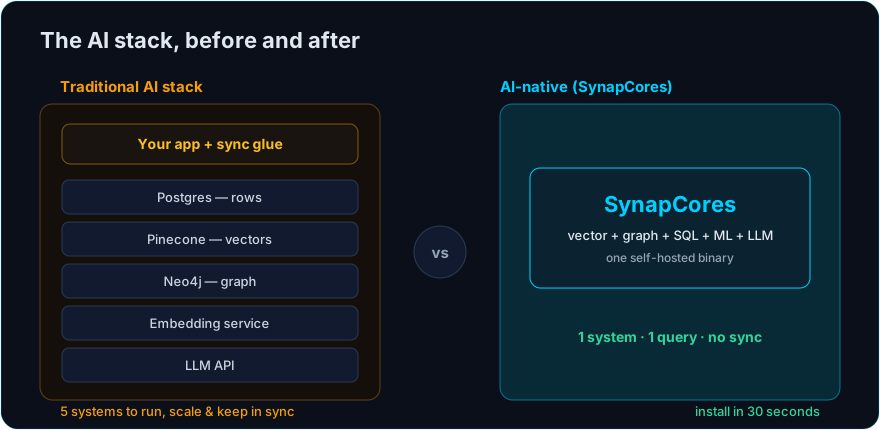
The phrases get used interchangeably, and they should not be. A vector database and an AI-native database are not two names for the same thing — one is a specialized component, the other is a category of engine, and conflating them leads teams to under-build their architecture and then wonder why the AI feature that demoed beautifully is so painful in production. A vector database is excellent at exactly one thing: storing embeddings and finding the nearest ones to a query, fast, at scale. An AI-native database treats vectors as one of several first-class data models inside a unified engine that also does graph, relational, and in-database machine learning. The distinction is not pedantic. It determines how many systems you run, how much glue you own, and whether your hardest queries are one statement or an orchestration problem.
This post makes the case carefully, because vector databases are genuinely good products being asked to be something they were never designed to be.
The AI-native engine here is SynapCores — vector, graph, SQL, and in-database AutoML in a single self-hosted binary, with native MCP and an OpenClaw long-term-memory plugin. The Community Edition is free. Download the free Community Edition →
A note on scope. Capabilities marked (Enterprise / roadmap) are part of the Enterprise tier or roadmap and are not in the free Community Edition today. Everything unmarked is in the free CE.
What a vector database is, and is excellent at
A vector database — Pinecone, Weaviate, Qdrant, Chroma, Milvus — exists to do approximate-nearest-neighbor search over high-dimensional embeddings. It indexes vectors (usually with HNSW), and given a query vector it returns the most similar stored vectors in milliseconds, even across billions of them. It is tuned end to end for that job: recall, latency, index build time, memory footprint. If your problem is "I have a pile of embeddings and I need the closest matches, fast, at huge scale," a dedicated vector database is the right tool and you should use one. For the foundational explanation, see What Is a Vector Database?.
The defining trait, though, is also the limit: it does one data model. Everything else an AI application needs lives somewhere else.
What "AI-native" requires that a vector database does not provide
An AI-native database is defined by unification, not by having a vector index. It holds vectors and graph relationships and relational rows in one engine, and it brings model inference inside the database rather than calling out to it. That changes what a single query can do. The capabilities a vector database structurally does not have:
There is no graph engine, so relationship-aware retrieval like GraphRAG requires bolting a second database alongside and keeping the two in sync. There is no relational model, so the filters, joins, and business rules that any real application needs live in yet another system. There is no in-database machine learning, so every prediction, embedding generation, or classification is an external service call rather than a function in your query. And there is no query planner spanning these models, so the engine cannot fuse a similarity scan with a relational filter and a graph walk into one optimized plan — because, from its point of view, the filter and the walk do not exist.
| Capability | Vector database | AI-native database |
|---|---|---|
| Vector similarity search | Excellent, the core job | Native |
| Relational data + joins | Not a data model | Native |
| Graph traversal / GraphRAG | Needs separate graph store | Native |
| In-database ML inference | External service | Native (PREDICT, EMBED) |
| Cross-model query planning | N/A — single model | One optimizer, one plan |
| Role in a stack | One component of many | The engine |
The hidden cost: you rebuild the stack around it
Here is how teams arrive at the confusion. They start with a single semantic-search feature, reach for a vector database, and it works wonderfully. Then the requirements grow the way they always do. They need to filter results by user permissions — so they query the relational database and intersect in application code. They need relationship-aware answers — so they add a graph database. They need to generate the embeddings — so they run an embedding service. They need to score results — so they add a model-serving layer. Step by step, around the vector database, they reconstruct exactly the five-system stack that AI-native architecture was meant to collapse — except now it is held together by application glue, and the vector store is one citizen of a city the team is maintaining by hand.
None of this is the vector database failing. It is the vector database being asked to anchor an architecture it was never meant to be the center of.
The same query, two architectures
Consider a realistic request: find documents similar to a question, keep only the ones this user is allowed to see, expand to related entities, and rank by a relevance model.
-- AI-native: one statement, one engine, one optimizer plan
SELECT n.title, n.content
FROM GRAPH_TRAVERSE(
       seeds => (
         SELECT id FROM documents
         WHERE :user_id = ANY(allowed_users)               -- relational filter
         ORDER BY COSINE_SIMILARITY(embedding, EMBED(:q))  -- vector search
         DESC LIMIT 6
       ),
       hops => 2                                            -- graph expansion
     ) AS n
ORDER BY PREDICT(relevance, :user_id, n.id) DESC;           -- in-database model
With a vector database at the center, that single statement becomes a sequence: query the vector store for candidates, fetch permissions from the relational database and filter in code, call the graph database to expand, call a model service to score, and re-assemble. Four systems, several network hops, and the consistency burden of keeping documents, embeddings, graph nodes, and permissions aligned across all of them.
When the distinction actually matters to you
If vectors truly are your whole problem — a pure semantic-search service, embeddings in and nearest neighbors out — a dedicated vector database is the better, more focused choice, and an AI-native engine would be over-scoped. Use the specialist when the specialty is the entire job.
The distinction starts to matter the moment your AI feature needs more than similarity: permissions and joins, relationships, in-query prediction, or all of them together. At that point, choosing a vector database means signing up to build and maintain the rest of the stack yourself, while choosing an AI-native database means those capabilities are already in the engine, already share one consistency boundary, and already compose in one query. We lay out the full evaluation framework in Best AI-Native Databases in 2026 and the architecture in AI-Native Database Architecture.
The summary is simple: a vector database is a component. An AI-native database is the engine. Knowing which one your problem actually calls for is the difference between a clean architecture and a stack you assemble by hand.
See the difference for yourself
The free Community Edition puts vector, graph, relational, and in-database ML in one binary, installable in about 30 seconds. Run the hybrid query above against it and count the systems you did not have to stand up.
Download Free → · What Is a Vector Database? → · See the live demos →